
Why Is My Block Wall Cracking?
What the Cracks Are Telling You
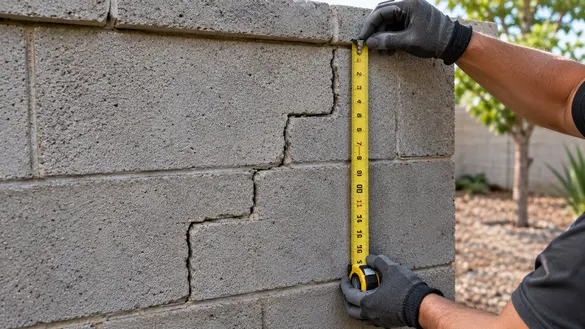
Not every crack is a problem
Block walls are made of lots of individual pieces held together with mortar, so they’re going to show some movement. A few hairline cracks from normal concrete shrinkage usually aren’t worth worrying about. What you’re looking for is a pattern: cracks that are growing, getting wider, or following a shape that points to a specific cause.
The four crack types and what they usually mean
Hairline vertical cracks. Usually shrinkage or minor settling. Vertical cracks are often just natural settling. Keep an eye on them, but there’s rarely a rush. Multiple vertical cracks, or one that keeps widening, is a different story.
Stair-step cracks. These zigzag along the mortar joints between blocks. They typically indicate differential settlement, where one section sinks faster than another. In Corona and the surrounding area, that often means the soil under part of the wall has shifted or the footing wasn’t deep enough to begin with. These are worth having evaluated.
Horizontal cracks. These run along a mortar line across the wall, and they’re the ones to take most seriously. Horizontal cracking typically points to structural stress, often from soil pressure or uneven settlement. If the wall is also bowing or leaning, that’s a sign something is pushing on it, usually soil and water behind the wall. On a retaining wall, this is the classic drainage warning sign. Our retaining wall page explains why drainage matters so much in clay-heavy soil.
Diagonal cracks. These often show up near corners or where the wall meets another structure, and they usually come from settling at one end. A crack that’s noticeably wider at one end than the other deserves a closer look.
Signs it’s more serious
- The crack is wider than a hairline, roughly the width of a pencil line or more
- It’s getting longer or wider over time
- One side of the crack sits out further than the other
- The wall is leaning or bowing
- There are several cracks in the same section
- You can see daylight through a gap, or mortar is crumbling out
A quick way to track it: mark the ends of the crack with a pencil and date it, or take a photo with a tape measure beside it. Check again after the next rain.
Why block walls crack in Corona and the Inland Empire
A few things work against walls in this area:
- Clay soil that swells and shrinks. It moves with the seasons and pushes against walls and footings. This is the leading cause of cracks on most of the Corona walls we see.
- Shallow or missing footings. Older walls and some builder-grade walls were set on a footing that isn’t deep enough for the soil.
- No rebar, or too little. Without steel inside the block cores tied into the footing, there’s nothing holding the wall together when the ground moves. We cover this on the block walls page .
- Water in the wrong place. Irrigation, downspouts, or poor grading pushing water against the base of the wall softens the soil underneath it.
- Tree roots and age. Roots lift sections, and mortar gets weaker over decades.
Repair or replace?
It depends on the cause, not just the crack. A single stable crack in a sound wall can often be repaired in place. A wall with multiple stair-step cracks, a failed footing, or a lean usually needs a rebuild, because patching it treats the symptom while the cause keeps working. Our wall repair page explains how we decide.
One more thing that matters: filling a crack with caulk or sealant without finding the cause is usually money wasted. If the ground is still moving, the crack will come back.
What to do next
- Photograph the cracks with a tape measure for scale
- Note whether they’ve changed since you first saw them
- Check where water goes near that section of the wall
- Don’t ignore a wall that’s leaning, especially next to a sidewalk, driveway, or neighbor’s yard
If you’re in Corona , Riverside , Jurupa Valley , Norco , Eastvale , or Moreno Valley , you can request a free estimate and we’ll look at the wall in person.
Frequently Asked Questions
Is a crack in my block wall serious?
It depends on the type. Thin vertical hairline cracks are often harmless, while stair-step and horizontal cracks usually signal settling or pressure and should be evaluated.
What do stair-step cracks in a block wall mean?
They follow the mortar joints and typically indicate differential settlement, where one part of the wall or its footing is sinking or shifting more than another.
Why is my block wall leaning or bowing?
Most often because of soil pressure and water behind the wall, a footing that’s too shallow, or ground movement. Leaning walls should be evaluated promptly.
Can I just fill the cracks with sealant?
Sealant can hide a crack, but it doesn’t fix the cause. If the ground or footing is still moving, the crack will usually reopen.
Does a cracked block wall need to be replaced?
Not always. A single stable crack can often be repaired, while a wall with multiple cracks, a failed footing, or a lean usually needs to be rebuilt.